
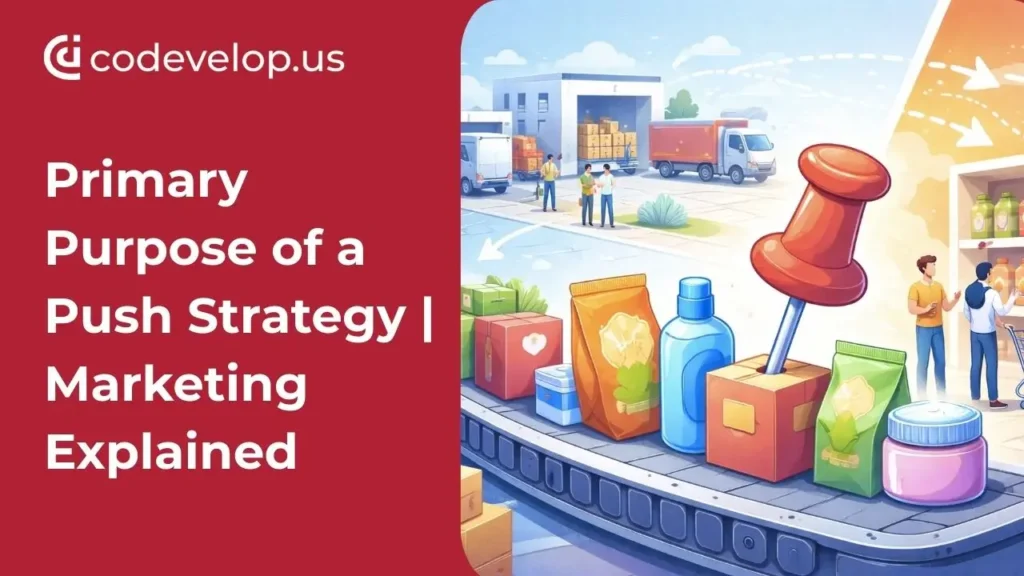
When people hear the term push strategy, they often think it sounds aggressive or outdated. Like something only big brands used decades ago. In reality, push strategies are still very much alive, and they quietly shape how many products reach customers every day.
At its core, the primary purpose of a push strategy is simple: to actively move a product through distribution channels so it reaches the buyer efficiently and consistently. Instead of waiting for customers to ask for your product, you make sure it’s already in front of them—on the shelf, in the catalog, or in the sales conversation.
That may sound obvious, but many businesses misunderstand where push strategies actually fit and why they matter.
What a Push Strategy Really Is (Without the Jargon)
A push strategy focuses on the supply side of the market. Instead of advertising heavily to end consumers, you invest your effort in motivating intermediaries—like distributors, retailers, resellers, or sales teams—to promote and sell your product.
In plain terms, you are saying:
“Let’s convince the people who sell products to customers to sell ours.”
This is very different from hoping customers discover you on their own.
The Primary Purpose: Control Distribution and Availability
The main reason businesses use a push strategy is control.
You control:
- Where the product is available
- How often is it recommended?
- How visible it is at the point of sale
A product can be excellent and still fail if it never reaches the customer. Push strategies exist to solve that exact problem.
You are not trying to create desire first.
You are making sure access exists first.
Why Push Strategies Still Matter Today
Some marketers assume push strategies died with door-to-door sales or old retail models. That’s not true. They just evolved.
Push strategies are everywhere:
- Software companies selling through partners
- Food brands fighting for shelf space
- Manufacturers working with distributors.
- Service companies using referral networks
- Franchise systems supporting local locations
In each case, the business isn’t relying only on customers to “pull” the product. They are actively shaping the path to purchase.
How Push Strategies Work in the Real World
Push strategies rely on incentives, relationships, and timing. Common tools include:
- Trade discounts
- Bulk pricing
- Sales commissions
- Dealer incentives
- Training programs
- Co-op advertising
- In-store promotions
- Priority placement agreements
None of these forces a sale. They encourage it.
You’re aligning your success with the success of the intermediary. When they win, you win.
Push Strategy vs Pull Strategy (Quick Clarity)
This comparison causes confusion, so let’s clear it up simply.
- A push strategy focuses on sellers and distributors.
- A pull strategy focuses on end customers.
Pull strategies create demand. Push strategies fulfill it.
Most successful businesses use both. But the primary purpose of a push strategy remains the same: move the product forward through the channel, not wait for demand to arrive on its own.
When a Push Strategy Makes the Most Sense
Push strategies work best in certain situations.
They are especially effective when:
- Your product is new or unfamiliar
- Your brand lacks awareness.
- Customers rely on recommendations.
- Shelf space or visibility is competitive.
- The buying process involves intermediaries.
If your customer doesn’t directly buy from you, a push strategy becomes critical.
The Psychological Side of Push Strategies
There’s a human element here that often gets ignored.
People trust recommendations from sellers they already rely on. A store clerk. A distributor. A consultant. A reseller.
Push strategies tap into that trust.
When intermediaries understand your product, feel supported, and see value in selling it, they naturally present it with confidence. That confidence transfers to the buyer.
The Risk of Misusing Push Strategies
Push strategies are powerful, but they’re not foolproof.
When misused, they can:
- Create excess inventory
- strain partner relationships
- Inflate short-term sales without loyalty.
- Increase costs without long-term growth.
The mistake many companies make is pushing too hard without building demand alongside it.
A push strategy should open doors, not force them.
Why Push Strategies Need Strategy, Not Just Budget
Throwing money at incentives doesn’t guarantee success. Smart push strategies are structured.
They answer questions like:
- Who influences the buying decision?
- What motivates them?
- What friction exists in the process?
- Where does visibility matter most?
Without clarity, a push strategy becomes expensive noise.
Push Strategies in Modern Digital Marketing
Push strategies aren’t limited to physical products.
In digital marketing, push strategies appear as:
- partner programs
- affiliate networks
- referral incentives
- reseller platforms
- co-branded campaigns
Even B2B SaaS companies use push strategies when they sell through agencies or consultants.
The concept stays the same. Only the execution changes.
Why Businesses Often Underestimate Push Strategies
Many businesses focus almost entirely on demand generation. Ads. Content. Social media. SEO.
Those things matter. But demand without distribution stalls growth.
If your product isn’t easily accessible when interest peaks, you lose momentum.
Push strategies protect you from that gap.
The Bigger Picture
The primary purpose of a push strategy isn’t to manipulate the market. It’s to reduce friction between your product and the buyer.
You are smoothing the path.
You are removing obstacles.
You are making the decision easier.
That’s not aggressive. That’s practical.
Final Thoughts
So if we strip away the terminology and keep it honest:
The primary purpose of a push strategy is to ensure your product reaches the customer efficiently by working through the people and systems that control access.
It’s about presence before persuasion.
Availability before awareness.
When used thoughtfully, push strategies don’t replace demand-building efforts. They support them.
If you’re building a growth strategy and are unsure whether a push approach fits your business, Codevelop can help you figure it out. We work with companies to design practical marketing strategies that balance demand creation with smart distribution—so your product doesn’t just exist, it actually moves.
Reach out to Codevelop, and let’s build a strategy that gets your product where it needs to be.
