
Why People Confuse Content Creation and Content Marketing
In the realm of the internet, people often use two words as if they have the same meaning: content creation and content marketing. Initially, it may seem similar because both involve producing and sharing information. However, the fact is that each serves a very distinct purpose for your brand’s online development.
If you wish to enhance visibility, better SEO, build authority, or convert more customers in 2025, it is vital to understand the difference between creating content and marketing content. Once you comprehend how each functions and supports the other, you can develop a strategy that not only appears impressive on social media but also provides long-lasting results.
What Content Creation Really Means
Content creation is like the starting point of all things. It’s how we make stuff that our audience really engages with and consumes. This can be writing interesting blogs, recording short videos, making reels, crafting social media post designs, composing email newsletters, or generating any type of content that assists individuals in interacting with your brand.
At its basic level, content creation is inventive. It changes thoughts, communications, and data into resources that people can view, read, watch, or hear. From the angle of SEO, creating content provides search engines with materials to organize and evaluate for rankings.
Without new, appropriate, and useful content, Google has nothing to present to users. This is the reason why regular creation of content forms the base for all natural growth. When you release content that addresses issues, replies to questions, provides perspectives, or motivates your audience, it naturally enhances your visibility.
How Content Marketing Powers Your Business

While content creation is about generating the material, content marketing concentrates on making that material connect with the appropriate audience and achieve genuine business results. The tactic underlying the information is known as content marketing.
This includes comprehending your target group, arranging themes that align with their requirements, optimizing all things for search engines, spreading information via social media platforms, transforming posts into various formats, and monitoring performance to enhance the strength of future materials.
Content marketing makes sure your content is not just there – it performs. This is what changes a blog into traffic for the website, a reel into awareness of the brand, and a social post into conversions. This strategic layer helps to create trust, authority, and lasting engagement.
Seeing the Difference Clearly
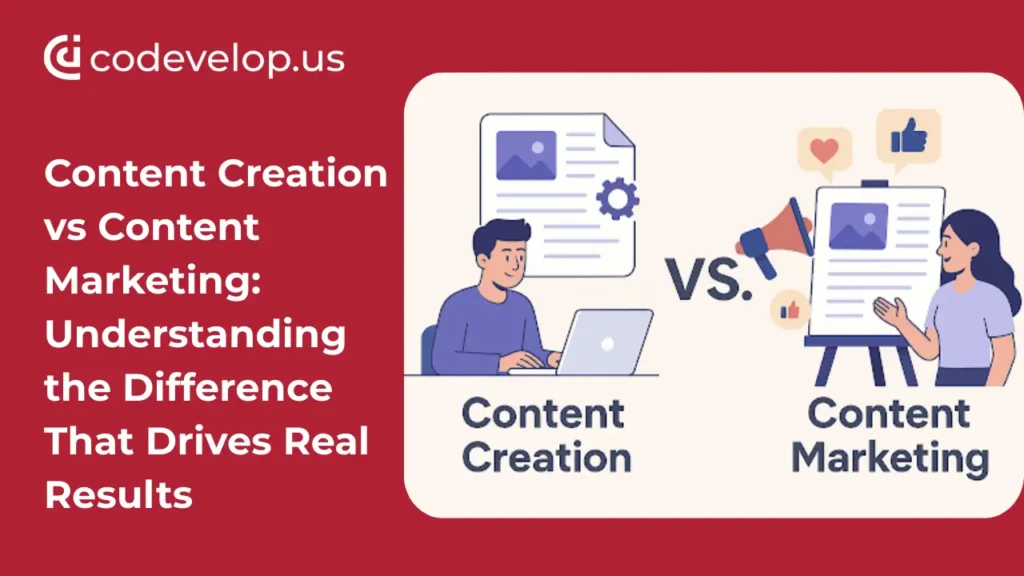
When you look at content creation versus content marketing, the difference becomes more understandable. Content creation is about “what,” while content marketing involves the “why,” “how,” “where,” and also “what next.” One forms the message; another generates momentum.
Even the most attractive reel or the best-written blog will not do well without a marketing plan supporting it. Conversely, even an excellent content marketing strategy cannot bring success if it does not have regular content to back it up. Both parts are important.
When brands mix these two up, they either make content with no direction or plan strategies that don’t get carried out. That is why knowing the difference aids you in making more effective plans, investing with greater wisdom, and achieving growth at a quicker pace.
A Real Example: Café Seasonal Drink Launch
Imagine a café introducing a new seasonal drink – this can show how both strategies work hand in hand. First, the content creation happens when the café takes an attractive photo of their product, records a warm and inviting video that demonstrates how to make it, writes extensively about current trends in winter drinks on their blog, and then revises the menu with captivating words describing this new offering.
All these elements highlight what exactly is special about this beverage and assist Google in understanding more about it. In the meantime, content marketing is how the brand activates everything. The blog uses local SEO keywords to be on top of search results for city winter drinks.
They include the reel in a week-long campaign designed to build up excitement. The information is distributed via email bulletins, partnerships with influencers, and social media. The responses from customers are used as fresh content to create more enthusiasm.
Analytical data helps identify which platforms bring in the most visitors. This mixture illustrates how creating content and marketing it function together to boost visibility, interaction, and sales. From the view of SEO, creating content provides Google with good materials to check and list.
Marketing this content then makes these materials stronger by sharing them widely, getting engagement reactions, backlinks from other sites, and smart optimization strategies. Content that is useful, well-organized, and related gets more recognition from Google, but they also look at how users are interacting with it.
By putting out quality content supported by effective marketing, you can naturally increase your ranking possibilities as search engines see your brand being active, authoritative, and trustworthy.
Conclusion
Content creation and content marketing might appear alike, but they serve very distinct functions in your digital triumph. Content creation endows your brand with a voice, generating the communications that define who you are. Conversely, content marketing guides this voice by making certain every piece of information connects with the appropriate audience while delivering tangible results.
One creates presence, the other gathers momentum. The brands that will flourish in 2025 are those that consider both as integral to a single system and not distinct duties. When creation and marketing join forces, you obtain content that does not merely exist online – it functions, ranks high, appeals to interest, engages actively, and finally converts.
That mixture is the one that brings about ongoing, durable development in a progressively challenging digital environment.
