
Key Takeaways
- Mapping data fields across four or more platforms means agreeing what each field actually represents once, then connecting every platform to that shared definition instead of mapping each pair separately.
- The reliability comes from a central field registry, consistent typing, and a clear rule for renames, not from adding more point-to-point mappings as platforms are added.
- The failures to design against are the same field meaning different things in different systems, silent type mismatches, and a rename in one platform breaking every mapping downstream.
Table of Contents
- What Does Mapping Data Fields Across Platforms Actually Mean?
- Why Does Field Mapping Get Harder Past Three or Four Platforms?
- How Do You Build a Reliable Field Map?
- Which Platform Should Own Each Field?
- Point-to-Point Mapping vs a Central Field Registry: Which Fits?
- How Do You Handle Field Type Mismatches, Renames, and Nulls?
- What Mistakes Do Teams Make Mapping Fields Across Platforms?
- Frequently Asked Questions About Cross-Platform Field Mapping
- Is Building a Proper Field Map Worth It for Your Team?
What Does Mapping Data Fields Across Platforms Actually Mean?
Mapping data fields across platforms means deciding, for every piece of data that moves between systems, what it’s called, what type it is, and what it means, so a value written in one platform is understood the same way when it lands in another. It’s an agreement layer that sits above the technical connections themselves.
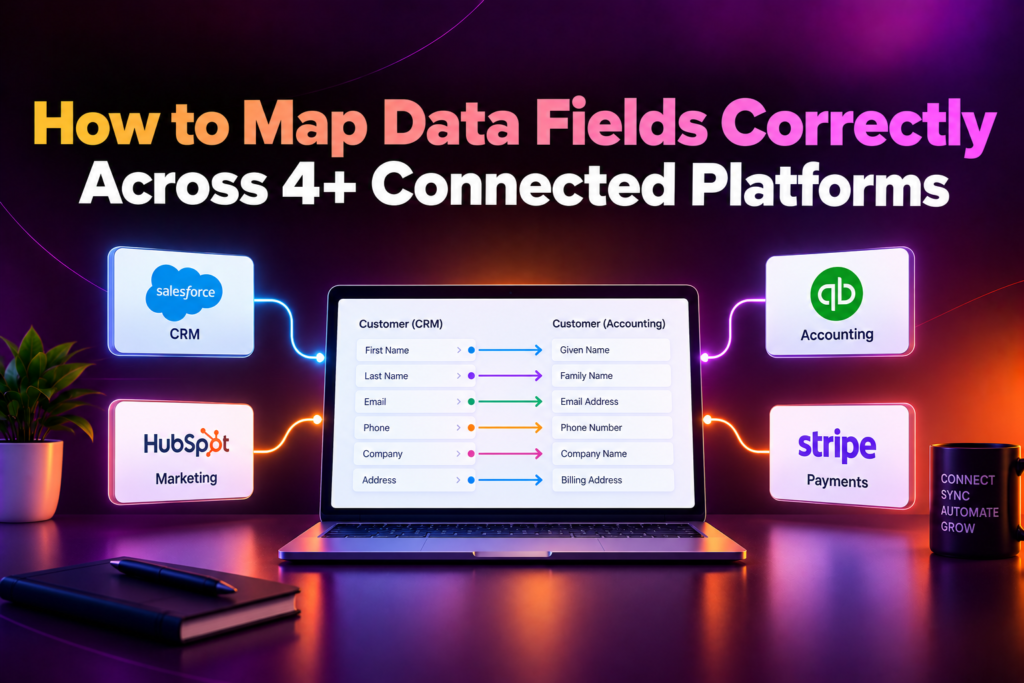
The complexity comes from the fact that platforms rarely agree by default. A CRM might call something “Company Name” while billing calls it “Account Name” and support calls it “Organization,” and all three might mean slightly different things by it. Mapping fields correctly means deciding these are the same concept, picking one canonical version, and making sure every platform’s version of that field translates to it consistently.
The everyday version: a customer’s phone number entered in the CRM shows up correctly formatted in billing, support, and a marketing tool, instead of arriving as a differently formatted string, a blank field, or the wrong customer’s number because two systems’ identifiers didn’t actually match.
Why Does Field Mapping Get Harder Past Three or Four Platforms?
Field mapping gets harder past three or four platforms because the number of relationships between them grows much faster than the number of platforms itself, so a mapping approach that worked for two systems becomes unmanageable once a handful more join the stack. Three platforms need three mapping relationships; six platforms need fifteen.
The gaps are usually mundane. A field renamed in one platform breaks a mapping built for its old name, and nothing catches it until a report comes back wrong. Two platforms both define “active customer” slightly differently, and a workflow built on one definition quietly misfires against the other. Each new platform gets mapped against whichever one was easiest to connect, rather than against a shared standard. Each is small on its own, and together they’re why a fifth platform added to an ad hoc stack breaks things that used to work.
Our integration services team sees the same root cause in most multi-platform data problems: every mapping was built to solve one connection at a time, with no shared definition anything else could be checked against.
How Do You Build a Reliable Field Map?
You build a reliable field map by defining each field once, independent of any single platform, and then mapping every connected system to that definition rather than to each other. The build follows a consistent sequence:
- Inventory every field in play. List what each platform calls the data it holds, including fields that look similar but might not mean the same thing.
- Define the canonical version. For each concept, agree on one name, one type, and one meaning that every platform will map to, regardless of what that platform calls it internally.
- Map each platform to the canonical field. Translate each platform’s version into the shared definition, handling type conversions and format differences at this step.
- Document ownership. Record which platform is the source of truth for each field, so conflicting values have a clear tiebreaker.
- Version the map. Treat the field map as a living document that gets updated and reviewed whenever a platform changes its schema, not a one-time setup task.
Our team runs every multi-platform project through this sequence, with the canonical field definitions agreed before any new platform is connected to the stack.
Which Platform Should Own Each Field?
Each field should be owned by whichever platform is the natural source of truth for that specific concept, so ownership is assigned field by field rather than one platform being treated as authoritative for everything. A CRM might own customer contact details while billing owns payment terms, even though both platforms reference the same customer.
In practice, ownership follows where a value is created and most reliably kept current. The system where a customer’s address is actually updated should own that field everywhere else it appears, and other platforms should treat their copy as a reference, not an editable original. This keeps four or five platforms from each holding a slightly different version of the same fact.
The edge worth naming is a field that genuinely gets updated in more than one place, like a support ticket status that also matters to billing. When that happens, the ownership rule needs an explicit sequence for which update wins, rather than leaving two systems free to overwrite each other’s version of the same field.
Point-to-Point Mapping vs a Central Field Registry: Which Fits?
Point-to-point mapping defines how each pair of platforms translates fields between just the two of them; a central field registry defines each field once and has every platform map to that shared definition. Point-to-point can work for two or three platforms, but a registry is what keeps four or more from becoming unmanageable. The table below shows where each fits.
| Aspect | Point-to-Point Mapping | Central Field Registry |
| Structure | Each platform pair mapped separately | One shared definition every platform maps to |
| Scaling past 3-4 platforms | Mapping pairs grows fast as platforms are added | New platform maps once, to the registry |
| Consistency | Same field can be defined differently in each pair | One definition per field, referenced everywhere |
| Maintenance | A rename means updating every affected pair | A rename is updated once, in the registry |
| Best for | Two or three platforms with simple, stable fields | Four or more platforms, or fields that change often |
| Example | CRM-to-billing mapping built separately from CRM-to-support mapping | “Customer ID” defined once and referenced by every connected platform |
A data layer built on our multi-platform integration work already defines canonical fields for common concepts like customer and account, so adding a new platform is mainly about mapping it to that existing registry rather than building fresh translations to every other system.
How Do You Handle Field Type Mismatches, Renames, and Nulls?
You handle type mismatches by converting explicitly at the mapping layer rather than hoping two platforms happen to agree, since a date stored as text in one system and as a timestamp in another will silently produce wrong values if the conversion isn’t handled on purpose.
Renames need a process, not a scramble. When a platform renames or restructures a field, the canonical map should be updated in one place, and every platform mapped to that canonical field inherits the fix automatically instead of needing separate patches.
Nulls are where mappings quietly fail. A field that’s required in one platform but optional in another will eventually arrive empty, and the mapping needs to define what happens then: a default value, a rejected record, or a flag for review, rather than letting an empty field propagate as if it were a valid answer.
What Mistakes Do Teams Make Mapping Fields Across Platforms?
Mapping platforms to each other instead of to a shared definition.
Without a canonical field, every new platform multiplies the number of translations that have to be built and maintained.
Assuming a shared field name means a shared meaning.
Two platforms both having a “status” field doesn’t mean they use the same values or the same definition of what status means.
No documented field ownership.
Without a clear source of truth per field, platforms end up with conflicting values and no agreed way to decide which one is correct.
Treating the field map as a one-time task.
Platforms change their schemas over time, and a field map that isn’t reviewed becomes wrong quietly, long after the initial setup.
Ignoring type and format differences.
Letting dates, currencies, or phone numbers pass through unconverted produces data that looks fine in the source system and wrong everywhere else.
No plan for missing or null values.
An unhandled null doesn’t stay contained. It propagates through every platform downstream as if it were a legitimate value.
Frequently Asked Questions About Cross-Platform Field Mapping
What does mapping data fields across platforms mean?
It means agreeing what each field represents, in name, type, and meaning, so a value written in one system is understood correctly when it reaches another.
Why does mapping get harder with more platforms?
Because the number of relationships between platforms grows much faster than the platform count itself, so an approach built for two systems doesn’t scale cleanly to four or more.
What’s the first step to building a reliable field map?
Inventory what every platform calls its data, then define one canonical name, type, and meaning for each concept that every platform will map to.
Which platform should own a given field?
Whichever platform is the natural source of truth for that specific field, decided one field at a time rather than assigning one platform ownership of everything.
Is point-to-point mapping ever good enough?
Yes, for two or three platforms with simple, stable fields. A central registry becomes worth building once four or more platforms are involved or fields change often.
How are field type mismatches handled?
By converting explicitly at the mapping layer, so a date, currency, or number format is deliberately translated rather than assumed to already match between systems.
What happens when a platform renames a field?
With a central registry, the canonical definition is updated once, and every platform mapped to it inherits the fix without needing separate repairs.
How should missing or null values be handled?
The mapping should define a default, a rejection, or a review flag for that case, rather than letting an empty value pass through as if it were valid data.
Does every platform need to use the same field names?
No. Each platform can keep its own internal names as long as it’s mapped consistently to the shared canonical definition of that field.
What’s the first step to auditing an existing multi-platform setup?
List every field currently being passed between platforms, check for concepts that are defined differently in different systems, and agree on canonical definitions before adding another platform. A short scoping call usually settles those decisions.
Is Building a Proper Field Map Worth It for Your Team?
If your business connects four or more platforms and shares customer, account, or transaction data between them, yes. A proper field map keeps a rename or a new platform from quietly breaking mappings that used to work, and keeps every system reporting the same facts about the same customer.
The exception is narrow. If only two platforms are connected and their fields are simple and stable, a direct point-to-point mapping may be all that’s needed. Most businesses pass that point as soon as a third or fourth platform joins the stack.
For everyone else, the real question isn’t whether platforms should agree on what a field means. It’s whether they agree by design, against one shared definition, or by coincidence, until the day a rename or a new platform breaks something no one expected.
Ready to see how your platforms should map fields to each other correctly? Book a scoping call and get a field-mapping worksheet before you connect another system.
